
DISCOVER MORE ABOUT THE STORY BEHIND
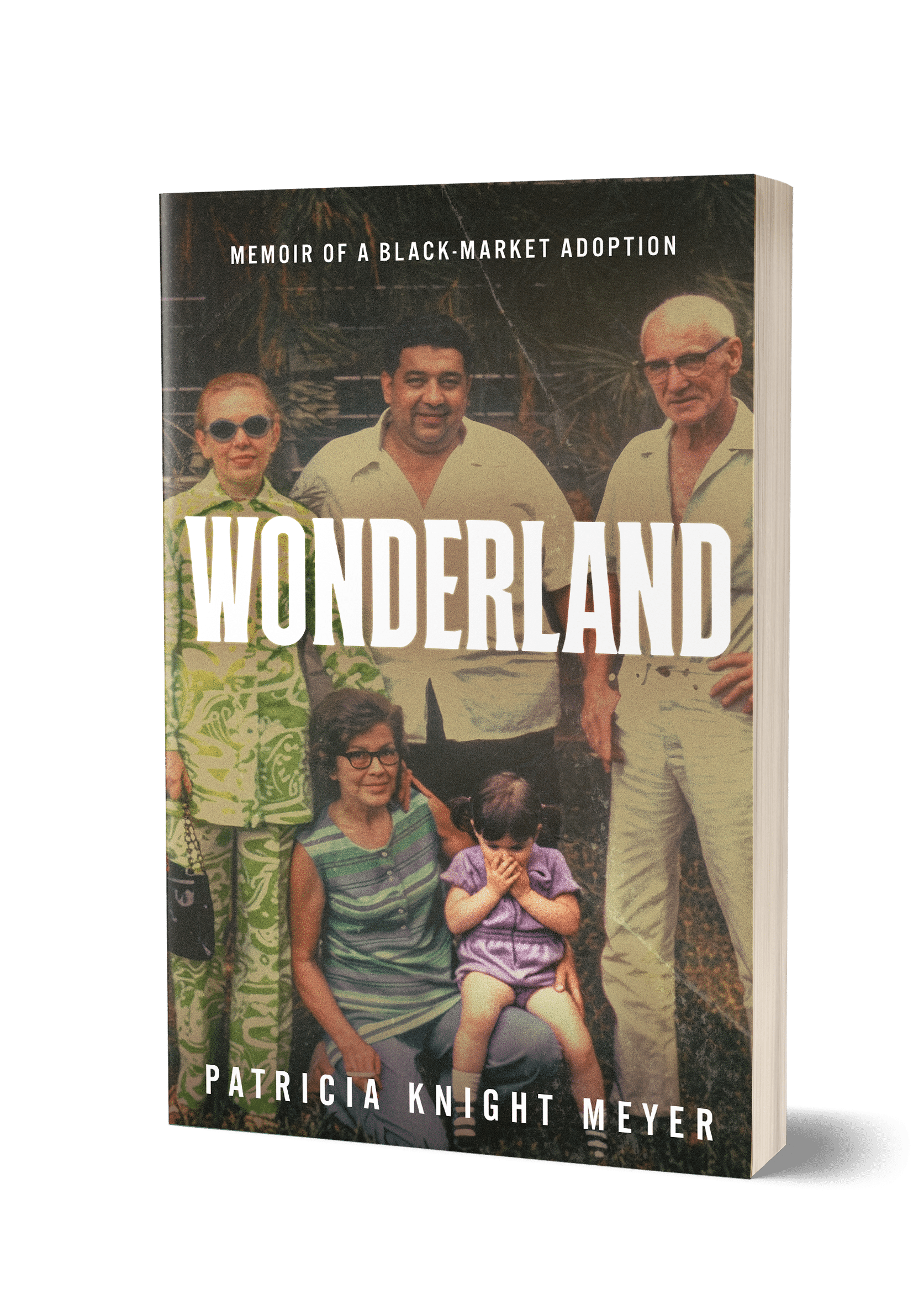
Wonderland Memoir of a Black-Market Adoption
A Memoir by Patricia Knight Meyer
Published by Unsolicited Press
Supplemental Materials
Welcome to the resource materials for WONDERLAND: Memoir of a Black-Market Adoption. Here you will find the following:
Easter Egg Audio
Did you find the Easter Egg audio? Have another listen below.
Did you find the audio relic? Click to listen...

Foreword by David Bohl
by David B. Bohl, MA, CSAC, MAC — Relinquishee and Adoptee, author of the memoir Parallel Universes: The Story of Rebirth and the monograph Relinquishment and Addiction: What Trauma Has to Do With It
Some stories arrive already knowing what they are, while others, especially the ones rooted in trauma, secrecy, and survival, take years to reveal their true identities. I knew Wonderland belonged to that very special second selection the moment I encountered it.
As an adoptee, I recognize in this story the quiet disorientation of growing up without a stable mirror; the sense of something essential missing, and the lifelong effort to construct an identity from fragments. As a mental health professional, I also recognize the predictable and tragic aftermath of a child's adoption trauma colliding with her parents' unresolved trauma. And as a fellow author, I recognize the rare courage it takes to tell such a story without reducing it into villains and victims.
Read The Full Foreword
I met Patricia in 2023 at the first Untangling Our Roots conference, where we discovered we shared a love for writing, sailing, and The Velveteen Rabbit. What we both loved about that book is the idea of becoming real. As the skin horse said, “it doesn’t happen all at once . . . it takes a long time.” And by the time it happens “most of your hair has been loved off.” The horse goes on to say “these things don’t matter at all, because once you are Real, you can’t be ugly, except to people who don’t understand.”
What I appreciate most about Wonderland is how it strives to provide a better understanding of the darker side of adoption, while acknowledging that we adoptees are not being ugly or unappreciative when we speak our truths. Once we understand who we are and what happened to us, that is when we become real.
This is not a book about addiction per se. But it is evident that addiction, and the havoc it wreaks, is the subtext atop which this story unfolds. Here, addiction lives in a household where substances are the family’s primary coping strategy for unacknowledged grief, for unnamed shame, generational trauma, and for losses never mourned. For readers unfamiliar with adoption trauma, it may be tempting to read these dynamics as isolated dysfunctions or moral failures. But Wonderland refuses such simplifications.
Decades of research have shown that relinquishment itself is a trauma, disrupting attachment, identity formation, and nervous system regulation. When a relinquishee is placed with caregivers battling their own trauma, the child’s developing psyche carries far more than it should. Seen through this lens, Patricia’s story becomes adaptive.
Her struggles are not random. Nor are they evidence of inherent brokenness. They reflect the collision of adoption trauma with family dysfunction, layered atop an already fractured beginning. One of the great strengths of this memoir is its refusal to collapse complexity into blame. Rather than ask us to excuse harm, Patricia asks us to understand it.
This is extraordinarily difficult work. For adoptees, there is often unspoken pressure to remain grateful, to protect the narrative of rescue, to silence anger in favor of loyalty. For children of addicted persons, there is a parallel pressure to manage, excuse, and emotionally parent the very people who are meant to provide safety. Wonderland explores the collision of these roles — the adoptee trying to love, live with, and save her addicted saviors — without sentimentality or excuses.
And then there is the matter of documentation. For an adoptee, whose identity is already shaped by legal erasure and reinvention, to live forty-seven years with a fraudulently obtained birth certificate is to move through the world without institutional recognition of one’s existence. This undocumented life becomes a powerful metaphor for the deeper question at the heart of this book: Who in the world am I?
Patricia also asks us to look beyond the individual and examine the systems that made such harm possible. Without adequate oversight, trauma-informed screening, and post-placement support, adoption can replicate the very conditions it claims to remedy. Wonderland does not argue against adoption. It argues for honesty and accountability. For a system willing to acknowledge complexity rather than relying on myths of salvation and gratitude.
At its core, Wonderland: Memoir of a Black-Market Adoption is a memoir about one woman’s ascent out of the dense fog of black-market adoption and into identity, belonging, and authentic self. It’s about the search for wholeness when your existence was never legally documented. How trauma cascades through generations, and the courage required to expose the truth.
This book asks us to resist binary thinking and to expand our capacity for compassion without erasing responsibility. For those willing to enter its depths, it offers a compelling journey and profound respect for the resilience of the human psyche. Ultimately, this is a story about one unbreakable woman becoming real.
— David B. Bohl
A tumble down the rabbit hole of America's baby trade.
Questions for reflection and discussion
Book club questions, grouped by theme (Identity and Belonging, Family Dynamics, Memory and Trauma, Adoption and Social Systems, Writing and Craft, Personal Reflection).
Identity and Belonging
The Rabbit Hole of Truth: Patricia describes her journey as a “tumble down the rabbit hole.” How does the Alice in Wonderland metaphor capture the disorienting experience of discovering your identity has been built on lies
The Ghost Kingdom: Patricia describes “peering into a past-life portal” of alternate lives she might have lived. How does the memoir explore these “what if” realities?
Family Dynamics and Complex Love
Love and Harm Coexisting: Patricia’s relationship with her adoptive mother is marked by both love and abuse. How does she balance these contradictory feelings? Can you relate to loving someone who has also harmed you?
The Mad Hatter’s Tea Party of Addiction: How does the memoir portray addiction and dysfunction (her mother’s alcoholism, her father’s obesity) without losing sight of love? Can trauma and devotion coexist in families?
Nature vs. Nurture: After reunion, Patricia realizes “I never fully appreciated how much my parents made me who I am.” What does this reveal about the interplay between genetics and environment in shaping identity?
Memory, Trauma, and Healing
The Dark Man and Memory: Patricia’s recurring nightmares haunt her childhood. How does the memoir explore the relationship between trauma, memory, and the body’s way of holding onto what the mind tries to forget?
Compounding Trauma and Resilience: The book explores “compounding trauma layers” — adoption trauma, family dysfunction, and black-market trafficking. How do these layers interact in Patricia’s life? How does she ultimately find resilience?
Adoption and Social Systems
Baby Scoop 2.0: In the post-Roe v. Wade landscape, adoption is increasingly promoted as “the solution” to unwanted pregnancy. What does this memoir reveal about the lifelong consequences for all parties involved? Are we headed into another Baby Scoop Era?
Baby Brokers and Profit: Patricia’s parents were blackmailed with the threat of taking back the baby. How does her personal story illuminate systemic issues in adoption’s $30 billion industry? What reforms does her story suggest are necessary?
Sealed Records: Sealed birth certificates and closed adoptions were designed to protect all parties. How does Patricia’s experience challenge this assumption? Who is really being protected by these laws?
The Gratitude Narrative: The memoir challenges the dominant narrative that adoptees should be grateful. How does Patricia complicate this narrative while still acknowledging love for her adoptive family?
Writing and Craft
Writing Your Truth: Patricia spent decades piecing together her story with fraudulent documents and fragmented memories. What does Wonderland teach us about the craft of memoir when trauma alters memory and the “official” record is a lie?
Structure and Metaphor: The three-part structure mirrors Patricia’s journey down the rabbit hole (Wonderland – Childhood, Through the Looking Glass – Adolescence, The Rabbit Hole – The Search). How does this structure enhance the storytelling?
Balancing Truth and Compassion: The memoir includes difficult content while maintaining compassion for all parties. How does Patricia achieve this balance? Is it possible to tell a painful truth without vilifying others?
Personal Reflection
Changed Understanding: Has Wonderland changed your understanding of adoption, identity, or family? What moments or scenes have stayed with you most powerfully? What conversations do you think this memoir should spark?
Resources / for further exploration
Book club questions, grouped by theme (Identity and Belonging, Family Dynamics, Memory and Trauma, Adoption and Social Systems, Writing and Craft, Personal Reflection).
Recommended Reading & Black-Market Adoption History Resources
To learn more about adoption reform, black-market adoption and adoptee rights:
- Visit Patricia’s blog at www.myadoptedlife.com
- Article: What is Black Market Adoption
- Visit my Amazon List of books on Black-Market Adoption
- Learn about your state’s laws regarding birth certificate access for adoptees
- Consider reading other adoptee-authored memoirs to hear diverse voices from the adoption constellation
Recommended Reading:
- God and Jetfire: Confessions of a Birth Mother by Amy Seek
- Relinquished: The Politics of Adoption and the Privilege of American Motherhood by Gretchen Sisson, PhD
- The Adoption Paradox by Jean Kelly Widner
- Parallel Universes: The Story of Rebirth by David B. Bohl
- Relinquishment and Addiction: What Trauma Has to Do With It by David B. Bohl
- Coming Home to Self: The Adopted Child Grows Up by Nancy N. Verrier
- Adult Adoptees and Writing to Heal: Migrating toward Wholeness by Liz DeBetta
- On Human Adoption: and the Manufacture of Identity by Dr Barbara Sumner
Endnotes
Endnotes (verbatim from the book, pages 343–344)
- E. Wayne Carp, Family Matters: Secrecy and Disclosure in the History of Adoption, (Cambridge, MA: Harvard University Press, 1998), 13; Michelle Kahan, “‘Put Up’ on Platforms: A History of Twentieth Century Adoption Policy in the United States,” The Journal of Sociology & Social Welfare, 33, no. 3 (2006).
- Rickie Solinger, Wake Up Little Susie: Single Pregnancy and Race Before Roe v. Wade (New York: Routledge, 2000), 88, 149. See also Ann Fessler, The Girls Who Went Away (New York: Penguin Press, 2006).
- Office of Justice Programs, “Babyselling – The Scandal of Black-Market Adoption,” National Criminal Justice Reference Service Virtual Library. Black-market adoptions comprised “at least one-third of all independent (nonagency) adoptions.” With ~35,000 independent adoptions in 1970 (20% of 175,000 total), this equals approximately 11,000 black-market adoptions.
- “Price for Babies Rising In Wider Black Market,” New York Times, April 25, 1976. nytimes.com/1976/04/25/archives/pricefor-babies-rising-inwider-black-market.html
- Erika Celeste, “Georgia Tann Tennessee Children’s Home Society Survivors Speak Out,” Business Insider, December 4, 2019. businessinsider.com/georgia-tann-tennessee-children-home-society-survivors-speak-out-2019-12
- “Price for Babies Rising In Wider Black Market,” New York Times, April 25, 1976. nytimes.com/1976/04/25/archives/pricefor-babies-rising-in-wider-black-market.html
- “Fighting for Rights After a Forced, Unethical Adoption.” The Phil Donahue Show. Original air date February 1981. YouTube
- “Ancestry.com” Wikipedia. en.wikipedia.org/wiki/Ancestry.com
- Edna St. Vincent Millay, “First Fig.” A Few Figs From Thistles. New York: Frank Shay, 1920.
- Jean A. S. Strauss, Birthright: The Guide to Search and Reunion for Adoptees, Birthparents, and Adopted Parents. Silver Tandem Books, 2022.
- Drumm, A. R., Davi, N., & Hanlon, R. (2025). Adoption by the numbers: 2021 & 2022. National Council For Adoption. Alexandria, VA.
- Amy Littlefield, “Whom Does Adoption Really Serve? A Q&A With Gretchen Sisson,” The Nation, March 18, 2024. thenation.com/article/society/gretchen-sisson-relinquished-interview-adoption
- Tik Root, “The Baby Brokers: Inside America’s Murky Private-Adoption Industry,” Time, June 3, 2021. time.com/6051811/private-adoption-america
Note: endnotes 4 and 6 cite the same New York Times article — this is how it appears verbatim in the book (two separate footnote references pointing to the same source).
INDIEREADER Discovery Awards Winner (True Crime) 2026
CIPA EVVY Book Awards Gold (Memoir) 2026
Eric Hoffer Book Award Finalist (Memoir) 2026
Next Generation Indie Award Finalist (Memoir) 2026
INDIES TODAY 2026 Award Winner - Finalist (Memoir) 2026
Magpie Zine's inaugural Clark Closser Memorial Literature Contest 2026 - Excerpt “Infant Of” Runner-up
Blair Publishers Bakwin Award (Manuscript) Shortlist 2024
C&R Press Prose (Manuscript) Award Shortlist 2025
Praise for Wonderland
"Tender, funny, quietly devastating, and deeply moving, Meyer transforms a profoundly personal story into something universal. As she searches for an answer to one of life's greatest questions — what does it mean to belong? — she crafts an unforgettable portrait of a woman born through the black market adoption system. With wit and remarkable emotional clarity, WONDERLAND is a profound meditation on the ways complicated family dynamics and invisible systems of power shape our lives."
— T. J. Raphael
"WONDERLAND is an important contribution to everyone in the adoption world. [. . .] It vividly shows the very real consequences when bad actors exploit the systemic vulnerabilities in the adoption system and—most pointedly—it provides a much-needed reminder of why transparency, equity, honesty, and adoptee-centered practices are vital. Oh, did I mention that it's a compelling read for almost anyone?"
— Adam Pertman
"Meyer's memoir, WONDERLAND, is its own rabbit hole. Her engaging, heart-wrenching narrative takes the reader down the windy, confusing, exhilarating tunnel that is adoption and adoption reunion. She pulls no punches as she shares with courageous honesty her story as an adoptee, raised in a beautiful and brutal home, who then searches for her birth community... Through her exquisite storytelling, Meyer can take us on this profound journey holding simultaneously the beauty and pain of her life as an adoptee."
— Rebecca C. Wellington, PhD
"In an absorbing and fast-moving narrative, Meyer conveys the complexity of the adoptee's inner life, shaped by uncertainty, hypervigilance, and deep, hearty—sometimes incongruous—love... Survival within her adoptive home is a constant focus, and adoption is ever-present, a force that expands and contracts her world, an alternately frightening and exhilarating wonderland."
— Amy Seek
"This memoir unfolds with the momentum of a television series—propulsive and immersive—yet grounded in precise dialogue and careful attention to scene and setting... Balancing narrative drive with clear psychological insight, the book illuminates the complex realities of adoption, including the lasting impact of falsified records, illegal practices, and unregulated systems."
— Dr. Liz DeBetta
With unswerving courage, compassion, and a commitment to discovering the truth, Knight weaves together and evokes the lived experience of adoptees, first parents, and adoptive parents. In scrutinizing the forces that shaped her life she gives voice to both the enduring wounds of adoption, the choices we make, and the transformative power of reclaiming our stories."
— Ronit Plank
"WONDERLAND forces readers to confront a reality that adoption narratives often avoid: that systems built on secrecy make ordinary people complicit in harm.... Clear-eyed and rigorously honest, this memoir belongs in any serious conversation about the legacy of the Baby Scoop Era."
— Julie Ryan McGue
"WONDERLAND is an unsettling and deeply necessary account of what can happen when maternal desperation collides with greed and systemic abuse. Patricia Knight Meyer's story is a haunting portrait of the Baby Scoop Era. But it's also a warning. As reproductive rights diminish state by state, this memoir argues that we may be headed toward Baby Scoop Era 2.0. Every legislator, every advocate, everyone who touches the child welfare system should read this book."
— Brienne Diebolt Brown
"WONDERLAND is essential reading for anyone in child welfare, psychology, law, and policy. But most of all, it's a riveting read. You might think this is an outlier story. It isn't. Read it twice. First, for the incredible story, then to descend with Patricia down the rabbit hole of lies, secrets and corruption that continues to plague child welfare today. Patricia is an accomplished advocate, a daring detective, and an excellent writer to boot."
— Dr. Joyce Maguire Pavao
This book rocked me to the core. I couldn't put it down.... This books speaks to all members of the adoption triad and their extended families. I highly recommend this book not only for the story but because it is so well written and engaging.
— Linda R. Sexton
"Patricia Meyer's story is a powerful testament to what happens when identity is built on secrecy, and what becomes possible when truth is finally uncovered... This courageous memoir offers hope to adoptees, parents, and anyone who believes that healing begins when we dare to face the truth."
— Bryan Post
A tumble down the rabbit hole of America's baby trade.